
Nano Aquarium Guide: Best Fish, Shrimp, and Plants for Small Tanks
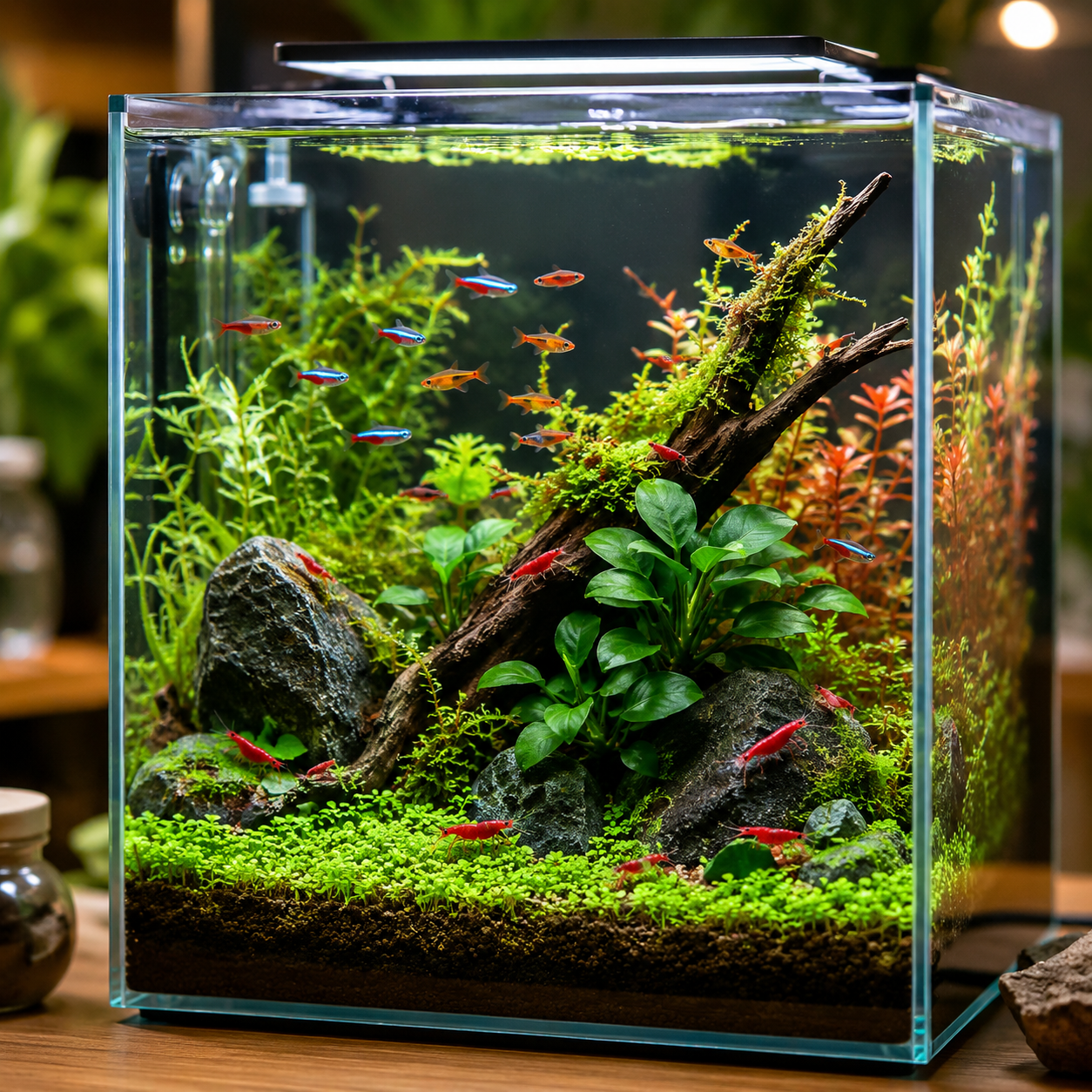
Nano aquariums — typically defined as tanks under 40 litres — have exploded in popularity among hobbyists in compact living spaces. For Singapore residents in HDB apartments, a nano tank offers an accessible entry point into the hobby: lower cost, lower water change volume, less furniture space, and — when done well — genuinely stunning visual impact.
The challenge with nano tanks is not their size but their stability. Small water volumes fluctuate in temperature, chemistry, and pH faster than larger setups. This guide explains how to work with those constraints and which inhabitants are genuinely suited to nano aquariums.
What Counts as a Nano Aquarium?
There is no universally agreed definition, but most hobbyists use:
- Nano: 10–40 litres
- Pico: Under 10 litres (extremely challenging; generally not recommended for fish)
This guide focuses on the 20–40 litre range, which is practical for most beginners while still presenting the stability advantages of a meaningful water volume.
The Nano Tank Challenge: Stability
Small water volumes present specific challenges:
Temperature fluctuation: A 20-litre tank changes temperature faster than a 100-litre tank when ambient temperature shifts. In a Singapore home where air-conditioning cycles on and off, a nano tank can fluctuate by 3–5°C in a day — enough to stress or kill sensitive fish.
Solution: A small, accurate heater; or choose species that tolerate Singapore's ambient temperature range (27–30°C) without a heater.
Water quality spikes: A single dead fish or missed water change in a 20-litre tank produces a far larger proportional chemistry shift than in a larger tank. The nitrogen cycle is more easily overwhelmed.
Solution: Light stocking, frequent water changes (20–25% twice weekly), and always running a cycled sponge filter.
Limited error margin: Mistakes in a nano tank show up faster and are harder to reverse.
Solution: Understock, and test water parameters regularly — especially in the first three months.
Ideal Filter for Nano Tanks
The sponge filter is the standard choice for nano tanks. It provides:
- Gentle flow (critical for small fish and shrimp)
- Biological filtration on the sponge surface
- No intake risk for small fish or shrimp
- Simple maintenance
- Low cost
A small internal filter or nano hang-on-back (HOB) filter also works for fish-only nano tanks. Canister filters are generally oversized for most nano setups.
For a full filter comparison, see Aquarium Filter Guide.
Best Fish for Nano Aquariums
Not all small fish are suitable for nano tanks. Some small fish are very active schoolers that need horizontal swimming space; others are territorial and need sightlines broken by planting.
Ember Tetra (Hyphessobrycon amandae)
Just 2 cm fully grown, intensely orange-red, and peaceful. A school of 15–20 ember tetras in a 30-litre planted nano is extraordinary. They prefer warm water (23–29°C) which suits Singapore's ambient climate.
Chilli Rasbora (Boraras brigittae)
Tiny (1.5–2 cm) with vivid red colouration and a black lateral stripe. A school of 15–20 chilli rasboras in a heavily planted nano tank with dark substrate is one of the most beautiful displays in the nano hobby. They prefer warm, slightly acidic water.
Mosquito Rasbora (Boraras brigittae / B. naevus)
Similar to chilli rasboras; tiny, red-toned, and suited to heavily planted nano setups.
Pygmy Corydoras (Corydoras pygmaeus)
At 2.5–3 cm, pygmy corydoras are the only cory species truly suited to nano tanks. Unlike their larger relatives, they are mid-water swimmers as well as bottom-dwellers. Keep in groups of six or more.
Endler's Livebearer (Poecilia wingei)
A close relative of the guppy, endlers are small (2–3 cm for males), hardy, and vividly coloured. Males display intense neon patterning. They breed readily and tolerate Singapore's ambient temperature well.
Betta (Betta splendens)
A single male betta in a well-planted 20–30 litre nano tank is the classic combination. Bettas are ideal nano fish: low bioload, don't need to school, and thrive in calm water. See Betta Fish Tank Setup Guide.
Clown Killifish (Epiplatys annulatus)
Small (3–4 cm) and strikingly patterned — striped body with vivid blue-red tail. A surface-dwelling fish that does well in calm, planted nano tanks.
Best Shrimp for Nano Aquariums
Shrimp are arguably better suited to nano tanks than most fish:
- Very low bioload
- No schooling requirement
- Constantly active and visually interesting
- Self-sustaining colonies in good conditions
Cherry Shrimp (Neocaridina davidi)
The most beginner-friendly freshwater shrimp. Available in red, yellow, blue, orange, and other colour morphs. Breed readily in good conditions. A 20-litre shrimp tank with java moss and a sponge filter can host a colony of 50+ shrimp. See Cherry Shrimp Care Guide.
Caridina Shrimp (Crystal Red, Crystal Black, Bee Shrimp)
More demanding than neocaridina — prefer very soft, slightly acidic water (pH 5.8–6.8, GH 3–5). Require more precise water chemistry but are strikingly beautiful. Not recommended as a first shrimp species.
Amano Shrimp (Caridina multidentata)
Larger than cherry shrimp (up to 5 cm); excellent algae eaters. Work well in planted nano tanks with fish that are too small to threaten them.
Best Plants for Nano Aquariums
A planted nano tank is the gold standard of small aquarium setups. Dense planting improves water quality stability, provides natural filtration, and creates the habitat conditions that nano fish and shrimp thrive in.
Foreground / Carpeting Plants
- Dwarf hairgrass (Eleocharis parvula) — forms a grass-like carpet; needs moderate light
- *Monte Carlo (Micranthemum tweediei 'Monte Carlo') — lush, round-leaved carpet plant; easier than HC cuba
- Marsilea hirsuta — small clover-like leaves; tolerates low light better than most carpet plants
Midground
- Anubias nana — tiny variety; attach to driftwood; virtually indestructible
- Bucephalandra — small, colourful rhizome plants; attach to hardscape
- Cryptocoryne parva — very small crypt; suitable for foreground to midground in nano tanks
Background
- Java moss — on driftwood, rock, or mesh; creates natural texture and surface area for biofilm
- Flame moss — grows upright with a distinctive twisted pattern
- Weeping moss — drapes over hardscape; beautiful cascading effect
Floating Plants
- Frogbit — round leaves; provides surface cover and rapid nitrate uptake
- Salvinia — small floating fern; thrives in warm water
For detailed plant care, see Low-Maintenance Aquarium Plants for Beginners.
Substrate for Nano Planted Tanks
For a planted nano tank, a nutrient-rich substrate (aqua soil) provides the best plant growth. Layer 3–5 cm of aqua soil as the base, optionally with a thin layer of fine sand on top for aesthetic and surface-dwelling species. See Aquarium Substrate Guide.
Sample Nano Tank Stocking Plans
20-litre planted shrimp tank:
- 20 cherry shrimp (starting colony — will grow)
- 4–6 otocinclus catfish (algae control)
- 2 nerite snails
- Sponge filter; java moss; anubias nana; floating frogbit
30-litre planted nano community:
- 1 male betta
- 4 pygmy corydoras
- 6 chilli rasboras (note: monitor betta temperament)
- 2 nerite snails
- Dense planting essential
40-litre ember tetra nano:
- 20 ember tetras
- 6 pygmy corydoras
- 10 cherry shrimp
- Sponge filter; planted with java moss, anubias, floating plants
Frequently Asked Questions
Is a 10-litre tank suitable for fish? With very few exceptions, no. 10-litre tanks are too small for any fish to thrive — water quality crashes rapidly, temperature is unstable, and no fish has sufficient territory. A single betta in a 10-litre unfiltered tank is widely acknowledged as inadequate housing. The minimum for any fish is 20 litres with a filter.
Do nano tanks need CO2? Not necessarily. Many beautiful planted nano tanks use no CO2 injection — low-tech plants (java moss, anubias, bucephalandra) grow well with standard LED lighting and liquid fertiliser. CO2 accelerates growth but significantly increases complexity and cost.
How often should I do water changes in a nano tank? Twice weekly at 20–25% per change is ideal for a stocked nano tank. More frequent, smaller changes are better than infrequent large ones — sudden chemistry shifts stress nano inhabitants.
What is the smallest recommended tank for cherry shrimp? Cherry shrimp can thrive in as little as 10–15 litres, but a 20-litre tank provides better stability. Shrimp-only tanks are considerably more forgiving than fish tanks at small volumes.
Can I keep a school of neon tetras in a 30-litre tank? Neon tetras prefer slightly cooler water (22–26°C) than Singapore's ambient range and are sensitive to water quality. A school of 8–10 in a well-cycled, planted 30-litre tank is possible but requires attentive maintenance. Ember tetras or chilli rasboras are better suited to nano setups in Singapore.